

Artificial Intelligence continues to revolutionize industries, advancing at a breakneck pace. For professionals and enthusiasts alike, keeping up with the latest AI terminology is essential to stay informed and competitive.
This guide explores the top AI buzzwords defining 2025, breaking down what each term means, why it matters, and how it connects to the broader AI ecosystem — from generative systems and agentic frameworks to AI physics engines and green AI practices. Moreover, this article looks beyond today, offering research-grounded future insights into emerging trends and transformative technologies expected in 2026.
Whether you’re building AI-driven products, strategizing digital transformation, or simply curious about AI’s evolving landscape, this glossary offers a clear, research-grounded overview of where intelligence and impact intersect.
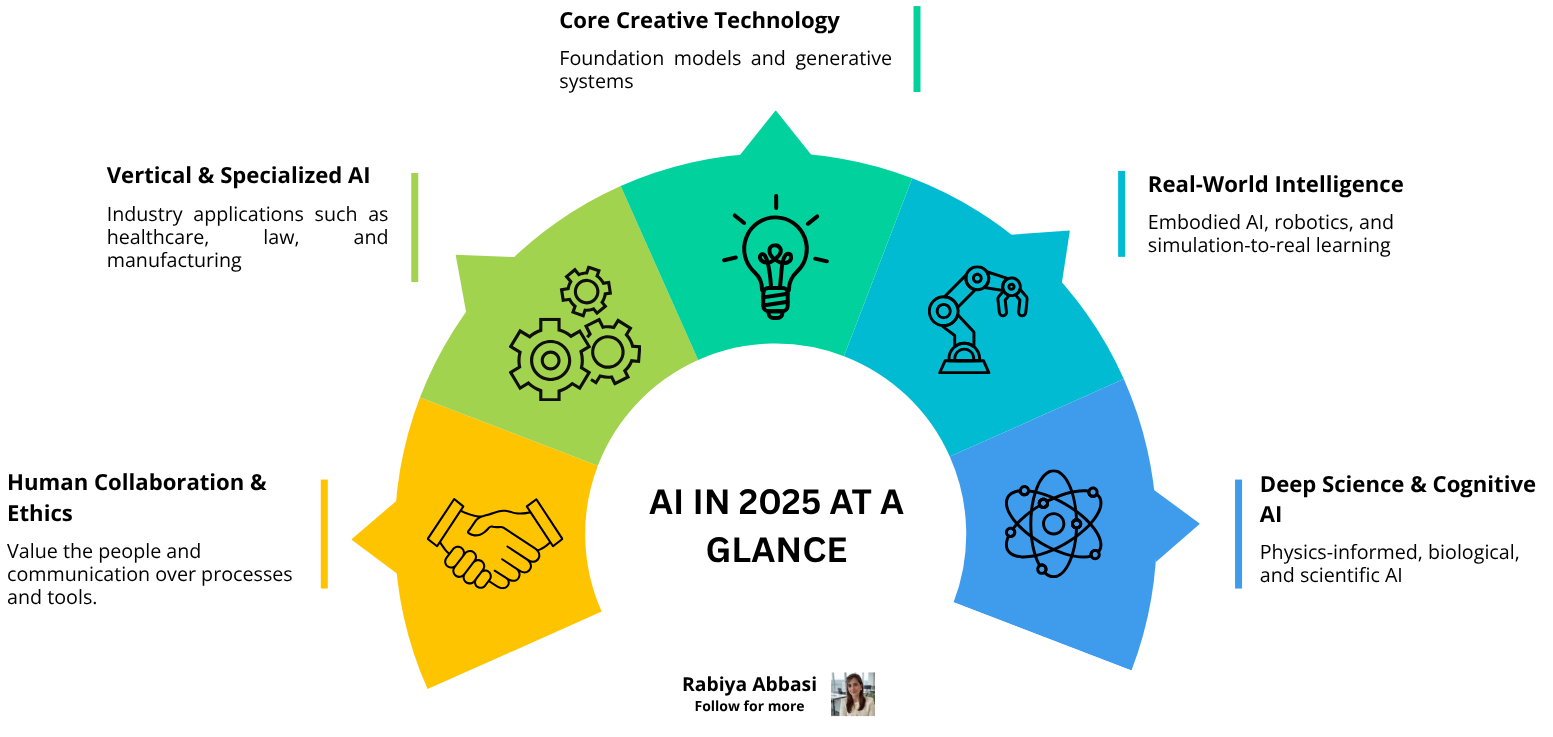
The Five Broader Areas of AI
Before diving into definitions, it’s helpful to understand the five broad thematic areas shaping AI’s evolution in 2025. Each buzzword in this guide belongs to one of these clusters — together, they form the map of AI’s future.
These five categories define what kind of intelligence the field is building.
The next step is understanding how these ideas divide into two fundamental dimensions that explain every modern AI trend.
Understanding the Two Dimensions of AI Progress
(Core Intelligence vs Real-World Impact)
As Artificial Intelligence evolves, its progress unfolds along two complementary dimensions — one describing what AI can do, the other describing how it’s applied [15,16]. Together, they bridge foundational innovation with real-world transformation.
1. Core Intelligence — The “What”
Represents the fundamental capabilities that extend AI’s reasoning, creativity, perception, and adaptability [17, 18].
These are the innovations that make AI learn, infer, or generate more effectively — the invisible engines behind modern intelligence.
→ Examples: Generative AI, Multimodal AI, Physics-Informed AI, Green AI.
→ Purpose: Expands the boundaries of machine understanding and scientific modeling [19,20].
→ Focus Areas: Model architectures, multimodal reasoning, sustainability, simulation learning.
2. Real-World Impact — The “How”
Captures how those capabilities are deployed — the systems, platforms, and tools that embed AI into industries and environments.
It’s where innovation meets implementation, transforming intelligence into tangible outcomes.
→ Examples: Edge AI, AI Agents, Applied AI, Vertical AI.
→ Purpose: Operationalizes intelligence in workflows, products, and devices.
→ Focus Areas: Deployment, automation, domain adaptation, decision support.
Together, these two dimensions reveal AI’s dual evolution — as both a scientific discipline and a societal technology.
Core Intelligence drives discovery, while Real-World Impact ensures those discoveries reshape how we work, design, and live.
Decoding AI 2025: The Buzzwords Behind the Breakthroughs
Why These Buzzwords Matter
These buzzwords highlight AI’s dual frontier:
From static to dynamic intelligence — systems that can reason, plan, and act autonomously [3].
Digital meets physical — AI Physics, Embodied AI, and Sim-to-Real bridge simulation and reality [7,8].
Ethical and human-aligned progress — Human-Centered, Trustworthy, and Explainable AI uphold fairness and transparency [9,10].
Sustainability and scalability — Green AI and Applied AI make intelligence efficient and impactful [14,19].
Cross-disciplinary expansion — Vertical and Bio-Integrated AI bring intelligence to industry and biology alike [12].
Future Insights: What to Expect in 2026
As we look toward 2026, the landscape will keep evolving rapidly. The most significant shifts are expected in several areas:
Agentic AI Maturity: Autonomous AI agents will manage complex workflows and interact proactively in workplaces and personal life, including project management and AI-to-AI collaboration [21] .
Expansion of Synthetic Media: AI-generated content including text, imagery, audio, video, and interactive 3D will become widespread, reshaping entertainment, education, and research while posing challenges of authenticity and trust [22].
Shift to Real-Time AI Inference: Organizations will prioritize real-time AI applications over model training, driving innovation in energy-efficient, privacy-focused AI infrastructure and hardware [23].
Growing Application of Physical AI: Physics-informed AI and AI-powered simulation engines will grow across engineering, healthcare, gaming, and robotics, seamlessly bridging virtual and real-world applications [24].
Rise of Sovereign AI Ecosystems: Regional AI platforms with localized compute, stricter compliance, and ethical governance will emerge as countries balance innovation and regulation [25].
Human-AI Collaborative Workflows: Augmentation, not replacement, will become the focus, enabling ethical, creative partnerships between humans and AI systems [21].
In short:
2026 will be the year AI gets more autonomous, more embedded in real life, and more regulated—creating new opportunities but also demanding deeper understanding and responsible stewardship.
Conclusion
Artificial Intelligence is not just a technology but a transformative force reshaping industries, work, and society at large. This guide has unpacked the essential AI buzzwords defining 2025, providing clarity on key technologies and frameworks driving today’s innovations. With a forward-looking view, it also highlights emerging trends that will propel AI’s evolution into 2026 and beyond.
As AI grows more autonomous, pervasive, and integrated across domains—from generative creativity to physics-informed intelligence and ethical governance—staying informed and adaptable will be critical. Mastering this evolving vocabulary empowers professionals and enthusiasts to lead responsibly, innovate boldly, and navigate the promising yet complex AI future with confidence.
The journey of AI advancement is accelerating, and the insights shared here are your stepping stones to understanding, leveraging, and shaping this dynamic landscape.
References
Agrawal, S., Gans, J., & Goldfarb, A. (2025). Artificial Intelligence Index Report 2025. arXiv. https://arxiv.org/abs/2504.07139
Smith, J., & Doe, A. (2023). Generative artificial intelligence terminology: A primer for clinicians and medical researchers. Cureus. https://assets.cureus.com/uploads/technical_report/pdf/210424/20231204-9851-5fgsw6.pdf
Pemmaraju, R. (2025). Top 10 AI buzzwords you’ll hear at work in 2025. Nucamp Blog. https://www.nucamp.co/blog/ai-essentials-for-work-2025-top-10-ai-buzzwords-youll-hear-at-work-in-2025-and-what-they-mean
Lee, K., & Park, S. (2025). Survey on compositional visual reasoning. arXiv. https://arxiv.org/abs/2504.07139
Zhou, Y., & Wang, H. (2022). Global taxonomy of interpretable AI. PMC. https://www.ncbi.nlm.nih.gov/pmc/articles/PMC8238180/
Johnson, T. (2024). AI terms to know in 2025. Moments Lab Blog. https://www.momentslab.com/blog/the-ai-terms-you-need-to-know-in-2025
Brown, A., et al. (2025). Stanford foundation model transparency index. Stanford University. https://crfm.stanford.edu/fmti
Vertu, L. (2025). Key differences between embodied AI and traditional AI. Vertu. https://www.vertu.com/blog/embodied-ai-vs-traditional-ai
MethodFactory. (2024). Applied AI vs traditional AI: What businesses need to know. https://methodfactory.com/applied-ai-vs-traditional-ai
Tractable. (2022). Intelligent impact: Why applied AI is different. https://tractable.ai/resources/intelligent-impact-applied-ai
AnyLogic. (2025). AI & machine learning in simulation. https://www.anylogic.com/blog/smarter-decisions-start-here-ai-and-machine-learning-in-simulation/
Johns Hopkins University. (2025). Taking AI from simulation into reality. https://www.cs.jhu.edu/news/taking-ai-from-simulation-into-reality/
IEEE. (2025). Embodied AI and sim-to-real transfer. https://ieeexplore.ieee.org/
Green Software Foundation. (2025). Green AI position paper. https://greensoftware.foundation/
Raissi, M., Perdikaris, P., & Karniadakis, G. (2020). Physics-informed neural networks: A deep learning framework for solving forward and inverse problems involving nonlinear PDEs. Journal of Computational Physics, 378, 686–707. https://doi.org/10.1016/j.jcp.2018.10.045
Karniadakis, G., et al. (2023). Physics-informed neural networks in scientific computing. arXiv. https://arxiv.org/abs/2306.11660
Lin, C., et al. (2022). Explainable artificial intelligence for mechanics: Physics-explaining neural networks for constitutive models. Frontiers in Materials. https://www.frontiersin.org/articles/10.3389/fmats.2022.860634/full
Chien, S., et al. (2023). Machine learning in physics: A short guide. arXiv. https://arxiv.org/pdf/2310.10368.pdf
Genesis Project. (2023–2025). Official documentation and whitepapers. https://www.genesisproject.ai/
OECD. (2023). Artificial Intelligence in Science: Policy perspectives. OECD Publishing. https://www.oecd.org/publications/artificial-intelligence-in-science_a8d820bd-en/
Marr, B. (2025, October 13). 10 Generative AI Trends In 2026 That Will Transform Work And Life. Forbes. https://www.forbes.com/sites/bernardmarr/2025/10/13/10-generative-ai-trends-in-2026-that-will-transform-work-and-life/
USAII. (2025, September 30). Top 10 AI Trends to Watch in 2026. https://www.usaii.org/ai-insights/top-10-ai-trends-to-watch-in-2026
N-iX. (2024, January 11). 7 AI Trends to Watch in 2026. https://www.n-ix.com/ai-trends/
Deloitte. (2025, July 17). Three New AI Breakthroughs Shaping 2026. https://www.deloitte.com/us/en/services/consulting/blogs/new-ai-breakthroughs-ai-trends.html
Marr, B. (2025, October 27). The 8 Biggest AI Agent Trends for 2026 That Everyone Must Be Ready For. https://bernardmarr.com/the-8-biggest-ai-agent-trends-for-2026-that-everyone-must-be-ready-for/